
By Engineva Research Team
SR&ED, AI
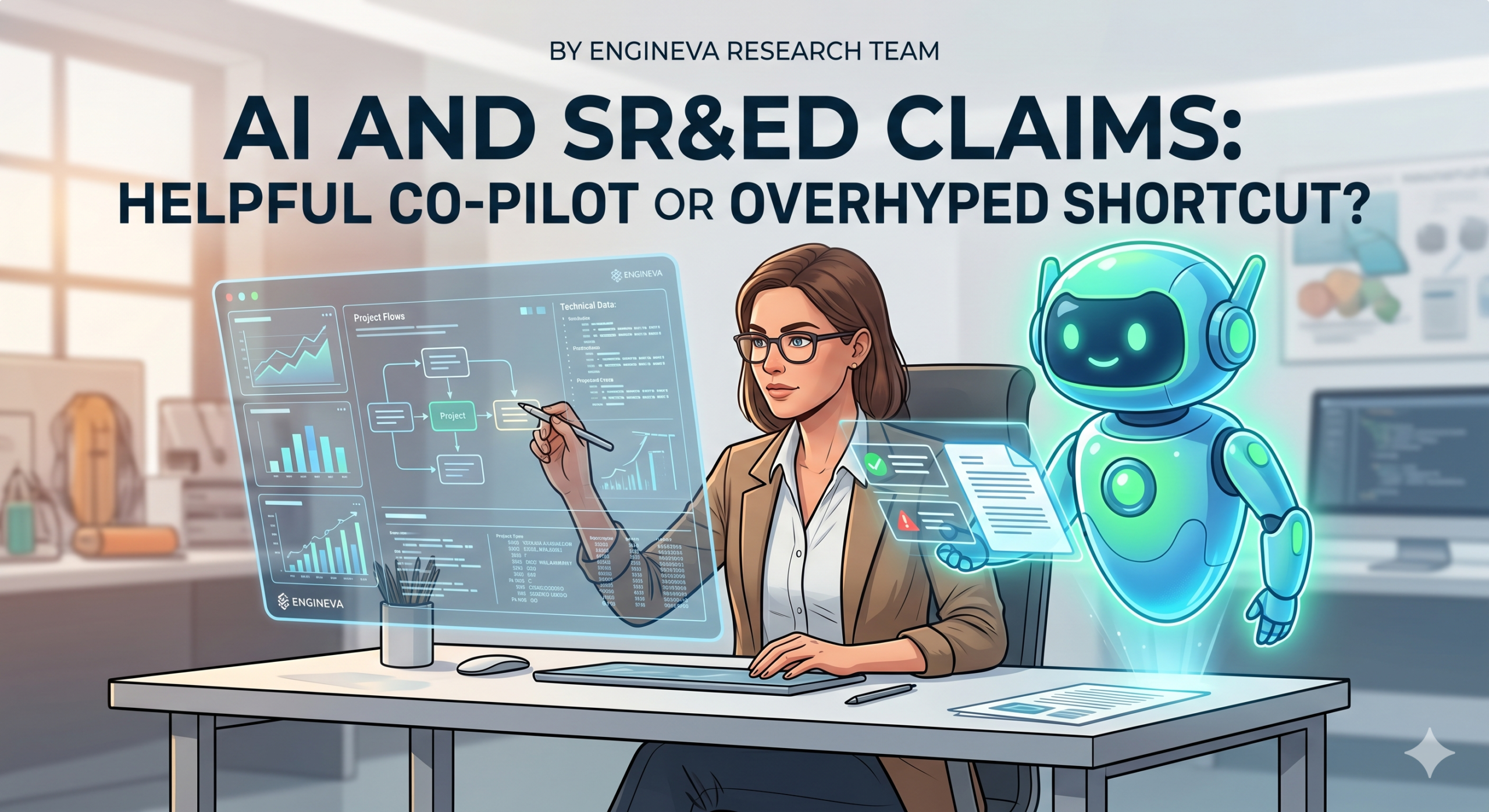
AI and SR&ED Claims: Helpful Co-Pilot or Overhyped Shortcut?
Artificial intelligence is everywhere right now. It is in your inbox, your search bar, your meeting notes, your photo editor, and probably hiding somewhere in your toaster.
Naturally, it has also made its way into the world of SR&ED claims.
Across the market, plenty of providers now describe their process as AI-powered, AI-driven, or AI-enabled. Sometimes that means there is meaningful technology behind the scenes. Other times, it means a basic form got a software upgrade and a shiny new label.
For SR&ED, that distinction matters.
AI can be genuinely helpful. It can organize information, summarize documents, speed up drafting, and flag gaps. But preparing a strong SR&ED claim is not a game of “feed the machine and wait for the magic refund.” It takes technical judgment, program knowledge, and a human who can tell the difference between routine development and a real technological uncertainty.
AI is a great assistant, but it is not the principal investigator
At Engineva, we like technology. We use modern tools wherever they genuinely improve speed, consistency, and quality. AI is good at sorting information, tightening structure, and turning scattered project notes into something more workable.
But SR&ED eligibility is not decided by how many buzzwords appear in a paragraph.
A successful claim has to explain what technological uncertainty existed, what work was done to resolve it, what experiments or analysis were performed, and what knowledge was gained. That takes interpretation. It takes asking the right follow-up questions. It takes understanding the project beyond the surface.
AI can help prepare the ingredients. It should not be the chef.
Automation wearing an AI costume
A lot of what gets marketed as AI is really automation. That is not a bad thing. Automation is useful. It can collect information, route documents, and prompt people through standard questions.
But let’s call it what it is.
An automated questionnaire is not an experienced technical advisor. A workflow tool is not an SR&ED strategy. A polished generated paragraph is not a defensible claim.
For example, automation might ask, “Did you face technical challenges?”
A strong advisor asks, “What was unknown at the outset? Why could the available knowledge not resolve it? What alternatives did you test, and what did the results teach you?”
That difference is where the value lives.
Why SR&ED still needs humans
SR&ED claims tend to involve messy, technical, real-world development. Software misbehaves. Manufacturing processes refuse to scale. Materials fail in strange ways. Biological systems ignore the plan. Prototypes work beautifully in the lab and then immediately embarrass everyone in the field.
This is exactly where human judgment earns its keep.
A good SR&ED advisor can work out whether the effort involved technological uncertainty, whether the activities were systematic, and whether the advancement is being framed at the right technical level. They can separate eligible experimentation from routine troubleshooting, business optimization, and ordinary implementation.
AI can summarize what happened. A human expert can tell you why it matters.
The risk of letting the robot drive
Lean too hard on AI and you get claims that look polished but feel hollow. They may sound impressive right up until someone asks, “So what was actually uncertain here?”
Overreliance tends to produce the same set of problems: missed eligible work, weak or ineligible activities swept in, generic narratives, and cost allocations that do not reflect the work performed.
The result is a claim that shows up in a sharp suit and then has nothing to say once the reviewer starts asking questions.
That is risky. SR&ED claims need to be clear, specific, and defensible. The goal is not the fanciest technical language. The goal is to explain the work accurately in a way that lines up with the program requirements.
Engineva’s approach: smart tools, smarter humans
Engineva is not against AI. Far from it. We think technology should be used wherever it adds real value.
We also think SR&ED claims should be human-led.
Our process pairs efficient tools with experienced technical review. We work with clients to understand their projects, identify the actual uncertainties, assess the development work, and prepare claims that reflect what really happened.
AI can help with the paperwork. Human expertise shapes the claim. That balance is the whole point.
The better question to ask
Instead of asking, “Do you use AI?” businesses should ask:
“Who is actually assessing my SR&ED eligibility?”
If the answer is mostly a questionnaire, an automated workflow, or a generic AI-generated draft, proceed with caution.
If the answer is an experienced advisor who understands the technology, the development challenges, the CRA’s expectations, and SR&ED claim strategy, you are in a much better place.
AI can make a process look modern. Expertise makes a claim stronger.
Final thought
AI is an impressive tool, and it will keep getting better. But for now, SR&ED claims still call for something AI does not truly have: judgment.
The best claims are not made by tossing project notes into a black box and hoping tax credits fall out the other side. They are built through careful technical analysis, thoughtful questioning, and a clear sense of what the program is designed to support.
At Engineva, we use technology where it helps. We just do not hand the judgment over to the robot.
Because when it comes to SR&ED, the future may be AI-assisted, but the strongest claims are still human-led.
📞 Book a consultation to explore how your winery’s innovation can qualify for SR&ED and other R&D incentives — turning each new vintage into a catalyst for discovery.