$700 Million and a Deadline: Southern Ontario’s AI Funding Window Is Open
Somewhere in your company there’s an AI project that keeps not happening.
Maybe it’s the predictive maintenance system your plant manager has been asking about for two years. Maybe it’s the product your engineers have working in a pilot, with three customers who’d pay for it if you could afford to finish it. Maybe it’s just the data cleanup that has to come before any of that, which nobody wants to fund because it doesn’t ship anything.
It keeps not happening because the capital cost is real and the payoff is a few years out, and in between there’s a budget meeting.
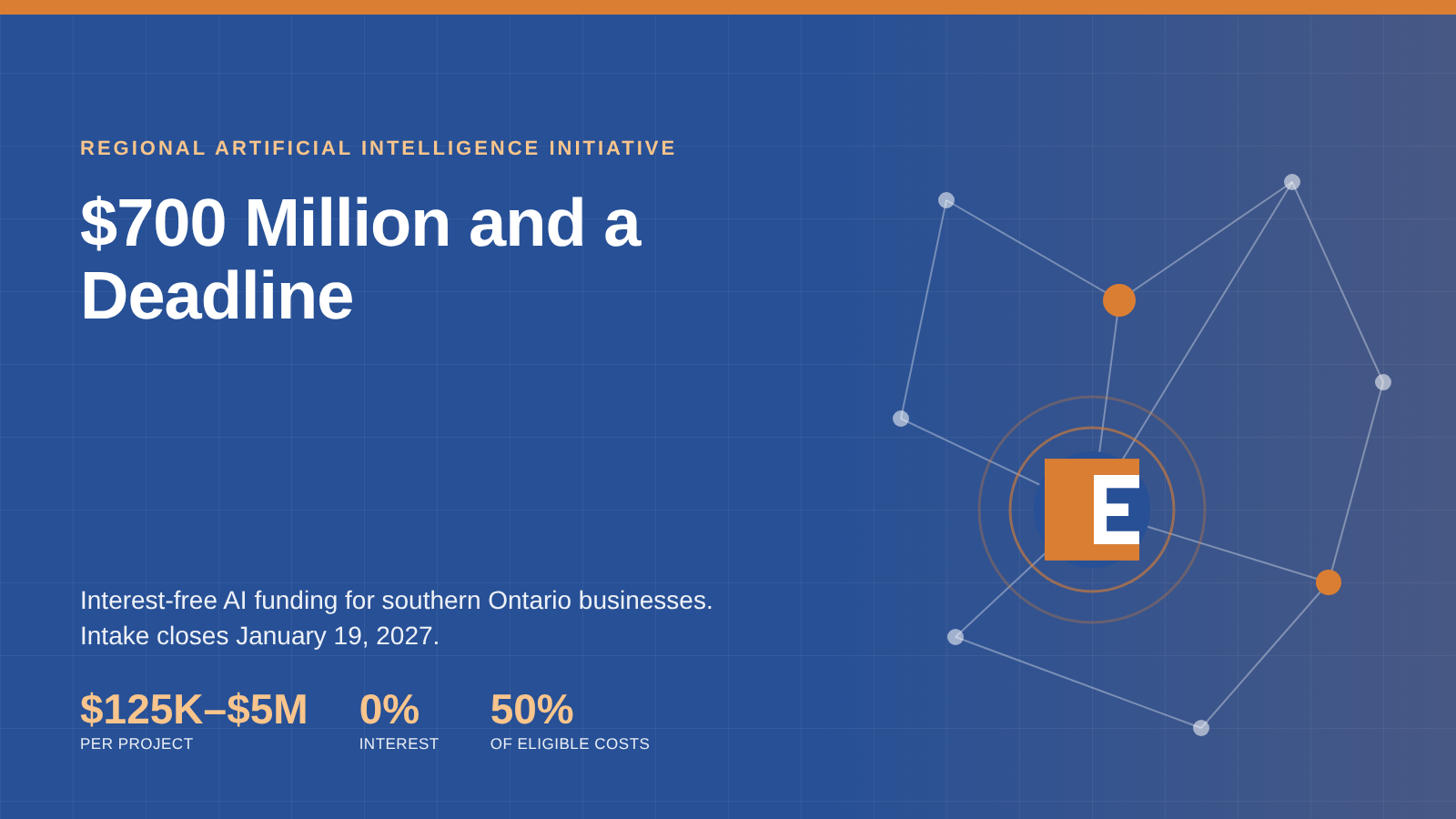
On October 13, 2026, that math changed. The federal government added $500 million to the Regional Artificial Intelligence Initiative, bringing it to $700 million, and FedDev Ontario opened a new intake for southern Ontario businesses. The terms: $125,000 to $5 million per project, covering up to half the cost, at zero percent interest.
The window closes January 19, 2027. Here’s what’s behind it.
Money that shows up during the project, not after
If you already claim SR&ED, you know the rhythm. You do the work, you close the fiscal year, you file, and some months later a refund arrives for a portion of what you spent. It’s a valuable source of funding, but it arrives after the fact, and it covers only the research itself.
RAII runs the other way around. You apply with a defined project, a budget and a timeline. If FedDev approves it, you sign a contribution agreement and they reimburse eligible costs as you incur them. The money arrives while you’re building, not after you’ve built.
For businesses, the contribution is repayable, but interest-free, and repayment doesn’t start until a year after the project ends. For a three-year project, that’s four years of someone else’s capital at no cost. There’s a parallel track for not-for-profits where the money isn’t repayable at all, which we’ve written about separately.
The other difference from SR&ED is what it funds. SR&ED pays for resolving technological uncertainty. RAII pays for the stuff on either side of that: the equipment, the integration, the validation with customers, the scaling, the training, the cybersecurity. The parts of an AI project that aren’t research but still cost money.
Two doors: adopting AI, or selling it
FedDev splits the business track into two streams, and the first thing to settle is which one you’re walking through.
The AI Adoption stream is for companies putting AI to work in their own operations. A manufacturer installing machine vision on its lines. A logistics firm integrating route optimization and predictive fleet maintenance. A food processor connecting demand forecasting to its production schedule. You need three years of operations and between five and 499 full-time employees, and the project has to go beyond buying commonly available tools. A subscription to a chatbot doesn’t count. A predictive analytics platform wired into your ERP does.
The AI Commercialization and Scale-Up stream is for companies selling a Canadian-made AI product or service. The bar for entry is lower, one year of operations and at least one full-time employee in southern Ontario, but the technology has to be at TRL 6 or higher, meaning a working prototype that’s been tested somewhere that looks like the real world. This stream funds the work of taking that prototype to paying customers, and then to more of them.
Both streams want the same baseline. You’re a for-profit business located and operating in southern Ontario, or a First Nations, Métis or Inuit business. You’re incorporated. You own, or will own, the IP the project creates. And you can show a commitment to responsible AI, which FedDev defines as cybersecurity, human oversight and accountability at minimum, with privacy, fairness and transparency layered on where the project calls for them.
That last requirement gets its own form. Two thousand characters to say who is accountable for the AI system, where humans stay in the loop, and what protects it. Companies that treat it as a formality tend to find out it wasn’t.
What FedDev funds, and what it doesn’t
The eligible activities list is long, and that’s the point. On the adoption side it runs from readiness assessments through acquiring and integrating the AI itself, the equipment and digital infrastructure to run it, re-engineering the processes around it, fixing the data so it’s trustworthy, training the people who’ll use it, hardening the cybersecurity, diversifying away from a single cloud vendor, and setting up the governance to keep humans in charge. On the commercialization side it covers testing, validating and demonstrating the product, refining it, scaling the infrastructure behind it as users grow, protecting the IP, getting the certifications, meeting the regulations, and bringing development or production work back to Canada.
In other words, almost everything an AI project costs, as long as it’s new, incremental and tied to the project. Machinery, software, the salaries of people hired or assigned to it, consultants, training, marketing, materials.
What it won’t pay for is also worth knowing. Land. Buildings. Vehicles. Refinancing existing debt. Your ongoing operating costs. The cost of preparing the application. And anything you’re claiming under SR&ED, which we’ll come back to.
FedDev also tells you where it leans. For adoption, five sectors get priority: healthcare and life sciences, energy and natural resources, transportation and logistics, agriculture, and manufacturing and robotics. For commercialization, priority goes to companies with market traction, meaning sales, exports or patent filings, or prior backing from an accelerator, incubator, angel or VC. Across both, projects that use Canadian suppliers, keep IP and data in Canada, or open AI opportunities to youth, Indigenous and rural communities get extra weight.
The fine print that decides whether you get paid
Up to 50% means you fund the other half, and FedDev is particular about where it comes from. Cash on hand, bank financing, investor commitments, other government programs. Not projected revenue. Not in-kind contributions. If approved, you have thirty days to sign and prove it, with bank statements, term sheets or funding letters. Since the floor is $125,000, the smallest project worth applying with is $250,000 all in.
There’s a ceiling on stacking, too. Total government assistance from every source can’t exceed 50% of capital costs or 75% of non-capital costs.
Costs can date back twelve months before your application, which means a project you started this spring may already be partly eligible. Projects must finish by March 31, 2031, and most run one to three years.
And then there’s the date most companies will miss. The intake closes January 19, 2027, but FedDev wants to accelerate projects with near-term impact, so anything with costs landing before March 31, 2027 should be submitted by November 24, 2026. If you’re ready to start in Q1, waiting until January costs you the early window.
Two housekeeping rules. You can have only one FedDev Ontario application under review at a time. And the form is an Adobe XFA PDF that has to be completed in Acrobat Reader on a desktop, which tells you something about how long it’s been since anyone redesigned it.
Not in southern Ontario? Same program, different door
Everything above is FedDev Ontario’s version of the rules, because that’s where most of our clients are. But RAII is a national program, funded by Innovation, Science and Economic Development Canada and delivered by all seven regional development agencies, each in its own territory.
Northern Ontario goes through FedNor. Quebec goes through Canada Economic Development for Quebec Regions. British Columbia has PacifiCan, the Prairies have PrairiesCan, Atlantic Canada has ACOA, and the territories have CanNor.
The two business streams are the same everywhere. What varies is the fine print: funding caps, cost-share percentages, minimum company size and, especially, intake dates, since each agency opens and closes its own window. If you’re outside southern Ontario, your agency’s page is the one to read, and the thresholds in this article are a guide, not gospel. The SR&ED side of the equation, though, is federal and works the same in every province.
SR&ED and RAII: same dollar, different programs
Here’s where it gets interesting for the companies we usually work with.
SR&ED and RAII are built to fund different phases of the same thing. SR&ED pays for the engineers who are resolving the hard technical problems in your AI model, the part where you don’t yet know if it’ll work. RAII pays for what happens once it does: validating it with customers, scaling the infrastructure, getting it certified, securing it, taking it to market. SR&ED is retroactive and non-repayable. RAII is upfront and interest-free. One rewards uncertainty, the other rewards a plan.
The rule that governs the overlap is simple to state and easy to get wrong. You cannot claim the same dollar twice. RAII explicitly excludes SR&ED-eligible costs, and the 75% cap on total government assistance applies across both programs. A salary can be SR&ED or RAII. It can’t be both.
What that means in practice is that the split has to be designed before you apply, in the work plan and the budget, not discovered afterward. Which engineers are doing experimental development and which are doing integration. Which months are research and which are deployment. Which costs go in the tax claim and which go in the contribution agreement. Done well, you get both programs at full value. Done carelessly, you either leave SR&ED money on the table or create a double-dipping problem that surfaces in a CRA review three years later.
It’s the kind of problem that looks like accounting and is actually engineering. Somebody has to understand what the work is before they can decide which program it belongs to.
The better question to ask
Most companies that look at RAII ask whether they qualify. The thresholds are public. You can answer that in five minutes.
The better question is: what’s the project we’d build if half of it were funded at zero percent and the other half were partly covered by SR&ED?
That’s a different conversation. It’s the one where the plant manager’s predictive maintenance idea becomes a three-line rollout with a data governance layer underneath it. Where the pilot with three customers becomes a scaling plan with certifications and a security audit built in. Where the data cleanup nobody wanted to fund becomes the first milestone of something that does ship.
FedDev assesses applications on exactly that. Not just eligibility, but the quality of the plan and budget, your ability to repay, your management and technical capacity, your partners, the outcomes you commit to in jobs, revenue and productivity, and how you’ve thought about risk. The applications that win put numbers on all of it. Not “improve efficiency” but “reduce unplanned downtime 30% across three lines, adding $1.2 million in annual capacity.” Not “commercialize our platform” but “move from three pilot customers to forty paying ones by 2028.”
The companies that benefit most will be the ones that treat RAII and SR&ED as one funding strategy, planned together, rather than two applications filed by two different people who never compared notes.
Final thought
The AI project that keeps not happening at your company isn’t stuck because the idea is bad. It’s stuck because the money is upfront and the payoff isn’t. RAII is the federal government offering to carry half of that gap, interest-free, for the next four years, and the intake closes January 19.
The companies that use it well won’t be the ones with the best AI. They’ll be the ones who designed the funding as carefully as they designed the product.
📞 Book a free 30-minute assessment and we’ll help you work out which stream fits, what your project could be worth, and how to split the costs between RAII and SR&ED so you get full value from both. Our engineers will help you shape the technical narrative, build a work plan and budget that hold up, and answer the responsible-AI and IP questions the way reviewers expect. Because the strongest AI projects, like the strongest claims, are still human-led.
Less Red Tape. More Funding. Built for Tech.
This article is for general information only and does not constitute professional tax, legal or financial advice. Program eligibility and funding amounts are determined by FedDev Ontario. Past results do not guarantee future outcomes.
Sources: Regional Artificial Intelligence Initiative in Southern Ontario · RAII for businesses: Who can apply · RAII for businesses: Application guide (FedDev Ontario)