
$3.45 Billion and a Running Clock: Ottawa Will Cover Half Your Payroll If the Tariffs Are Hurting You
Somewhere in your business there’s a number you’ve stopped saying out loud.
Maybe it’s the duty line on the broker’s invoice, which was zero a year ago and is now the biggest cost on the page. Maybe it’s the U.S. customer who bought from you for a decade and went quiet in August. Maybe it’s the quote you lost to a plant in Ohio because your price now carries 50% at the border and theirs doesn’t.
You’ve absorbed it so far, because the people on the floor are good and you’d rather eat margin than lose them. But absorbing is not a plan, and the balance sheet knows it.
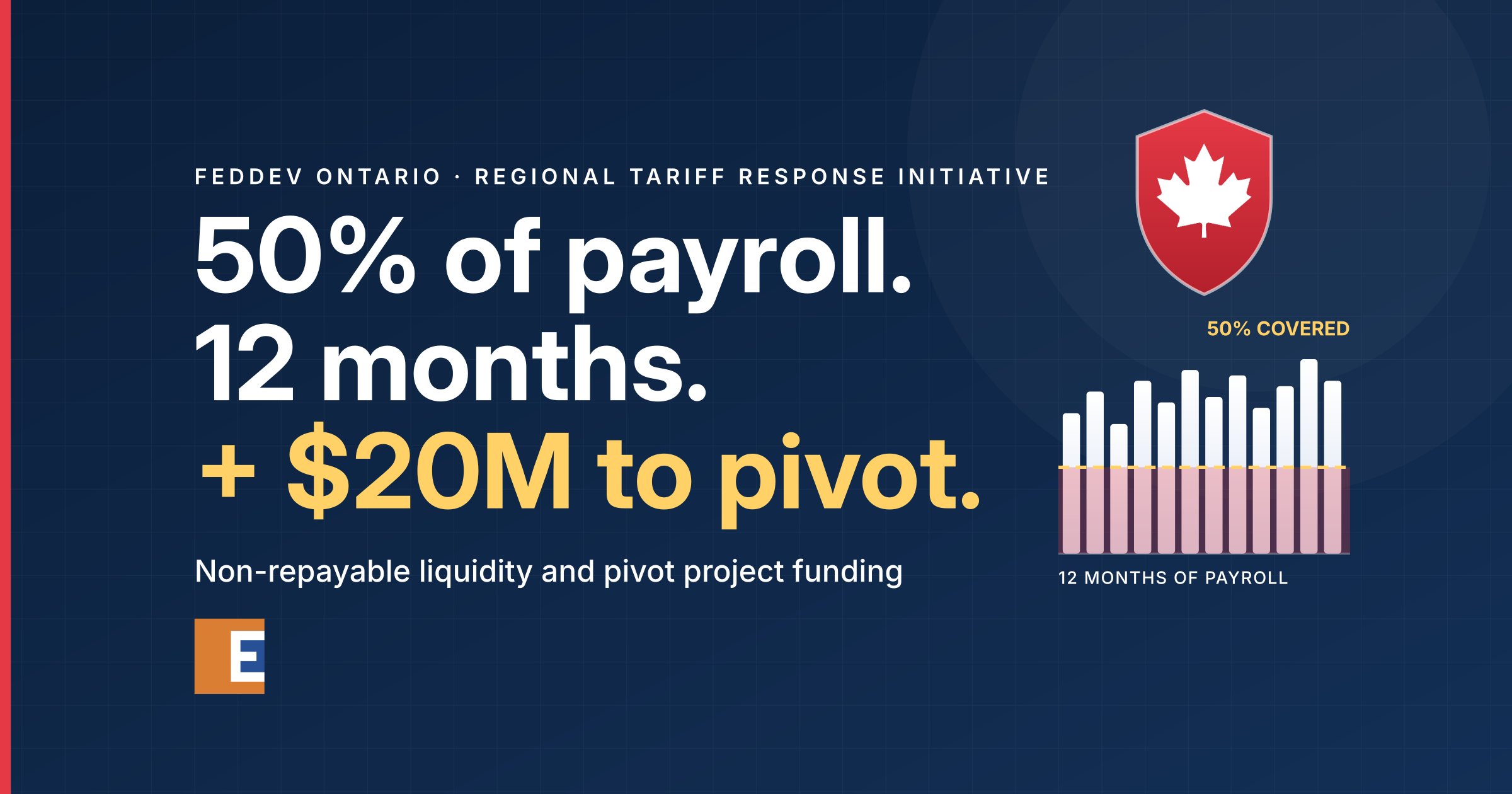
The federal government has put $3.45 billion into the Regional Tariff Response Initiative, delivered in southern Ontario by FedDev Ontario. The terms, for a business that can show tariff damage: a non-repayable payment equal to half your average monthly payroll, for up to twelve months, capped at $2 million. On top of that, up to $1 million non-repayable, or $20 million in total with interest-free repayable money, for a project that gets you out from under the exposure.
There is no published application deadline. There is something worse: the liquidity money runs for twelve months and must end by March 31, 2028, so every month you wait is a month of payroll support you don’t get back. Here’s how it works.
Two doors: keep the lights on, or change the business
RTRI is a national program run by all of Canada’s regional development agencies, and it is part of Ottawa’s broader tariff response plan. FedDev Ontario delivers it in southern Ontario, which is where most of our clients are, so FedDev’s rules are the ones in this article.
For businesses, the program has two streams, and you can walk through either door or both.
The first is liquidity assistance. It exists to keep you operating and your people employed while the tariffs are doing their damage. It is non-repayable, it is sized off your payroll, and it is meant to be fast. You don’t need a project to get it. You need to show that the tariffs hurt you, that you were viable before they did, and that you have a real cash shortfall over the next twelve months.
The second is a pivot project. This is money for doing something about the exposure: new equipment, automation, a new market, a reworked supply chain, anything that leaves you less dependent on a border that has stopped behaving. Up to $1 million is non-repayable. Beyond that, FedDev will lend interest-free.
The two are designed to be combined. A business can take up to $2 million in liquidity support plus a $1 million non-repayable pivot project, for $3 million of money it never pays back. Add a larger repayable project and the aggregate ceiling is $20 million. The intent is plain enough: survive the next year, and use that year to become a company the next tariff can’t hurt as badly.
Half your payroll, for a year, and you don’t pay it back
The liquidity formula fits on a napkin. Take your eligible payroll for the last twelve completed months, divide by twelve, and FedDev will pay 50% of that figure every month for up to twelve months, to a maximum of $2 million. A company with $150,000 a month in eligible wages is looking at $75,000 a month, or $900,000 over the year.
“Eligible” is where the napkin gets crowded. Payroll means salaries and wages paid to employees working in southern Ontario, and nothing else. Contractors are out. Dividends, owner draws and shareholder distributions are out. Bonuses, including retention bonuses, are out. Severance is out. Staff in your U.S. warehouse are out. And any payroll already covered by another government program, EI Work-Sharing in particular, comes off the top.
If 50% of payroll doesn’t cover the hole, there’s a second lever. On an exceptional basis, FedDev may add up to 50% of your essential operating costs: rent or lease payments, utilities, business insurance and property taxes. Not raw materials, not inventory, not interest, not the tariffs themselves. That last one surprises people. The duty you’ve paid is evidence of harm. It is not a cost the program reimburses.
The number that actually gets approved is the lowest of three: the payroll formula, your demonstrated shortfall from a twelve-month cash flow forecast, and $2 million. FedDev does not fund a need you haven’t shown, and it nets out any other government assistance you receive along the way. The funding period must end by March 31, 2028.
There’s a commitment attached. You attest that the money will be used to maintain Canadian operations and employment, you report on payroll and headcount during and after the period, and you accept that if the tariffs come off or a trade deal lands, the payments can be reduced or stopped. Existing RTRI recipients can apply for this too, back to August 22, 2025, as long as the same cost isn’t funded twice.
Pivot projects: the money for changing direction
Liquidity buys time. A pivot project is what you do with it.
FedDev funds projects that improve productivity, raise competitiveness, or cut your exposure to the next trade disruption. The eligible list is broad: process modernization, automation and digitization, new equipment, market diversification and export development outside the U.S., supply chain resilience, and anything else that makes you harder to hurt. A furniture maker that builds a Canadian retail channel so it isn’t 75% dependent on American wholesalers. A metal fabricator that automates a line so it can win domestic work at a price that doesn’t need the U.S. volume. A food processor that qualifies for the EU.
Up to $1 million, FedDev’s contribution is non-repayable and covers up to 50% of eligible costs, provided the project shows economic benefit beyond your own walls. Over $1 million, the contribution becomes repayable, interest-free, at up to 75% of costs, with the repayment schedule set in your agreement. Costs can date back twelve months before you apply, so a project you started this spring may already be partly eligible. Everything must be finished by March 31, 2029.
The fine print follows the pattern of every FedDev program. Total government assistance from all sources normally can’t exceed 90% of project costs. Your share has to be real money: cash, a bank facility, an investor. Not in-kind, and not revenue you expect the project to generate. Land, buildings, vehicles, refinancing and ongoing operating costs are out. And the budget has to add up three ways, by fiscal year, by cost category and by funding source, to the dollar.
If you’re combining streams, one rule matters more than the others: the same salary can’t sit in both. Project labour in the pivot budget must be carved out of the payroll you used for liquidity, and the jobs you say the pivot creates or maintains can’t be the jobs the liquidity money is already keeping.
Where SR&ED fits. If you claim SR&ED, the same discipline applies across programs. Non-repayable government assistance tied to a salary generally reduces the SR&ED base for that salary, and a pivot project that involves genuine experimental development, a new process you’re not sure will work, say, may have costs that belong in the tax claim instead of the contribution agreement. Which engineers, which months, which dollars. The split has to be designed before either file is submitted, not discovered in a CRA review three years later.
Who qualifies, and how FedDev decides you were hit
The baseline is short. You’re an incorporated, for-profit business located and operating in southern Ontario. You had at least $1 million in revenue in one of your last two fiscal years. You were viable before the tariffs, which FedDev reads from your financial statements and your operating history. Companies formed after March 21, 2025 are looked at case by case. Not-for-profits that support businesses have their own track, but can’t get liquidity money for themselves.
The real test is tariff impact, and FedDev gives you several ways to pass it. You operate in a sector hit by the Section 232 or Section 338 tariffs, directly as an exporter or indirectly as a supplier to one. At least 25% of your revenue comes from goods that end up in the U.S. Your input costs rose because of tariffs or Canada’s counter-tariffs. Your supply chain broke. You lost customers or revenue.
In November 2026, that net catches a lot of southern Ontario. Section 232 has covered steel, aluminum and copper since 2025, with the derivative list expanded in June 2026 to forklifts, bulldozers and other mobile machinery. Autos not built in the U.S. carry 25%. Softwood lumber carries 35%. Upholstered wooden furniture and kitchen and bathroom cabinets have carried 25% since October 14, 2025. Then the Section 338 lists landed: 50% on dairy, alcohol and a “motor vehicles” list that in fact covers electronics, furniture, building materials, plastics, clothing, toys, machinery, cosmetics and plants, effective August 22, 2026; a second 50% list on September 15 adding paper, steel and aluminum products, leather, motorboats and golf carts; and from September 29, an outright import ban on Canadian beer, wine, spirits and motorcycles. CUSMA compliance doesn’t help against Section 338. And the de minimis exemption that let small shipments cross duty-free ended in August 2025, which is how a lot of direct-to-consumer businesses found out they were exporters.
On the other side of the border, Canada’s counter-tariffs on U.S. goods, updated September 8, 2026, mean a company that never ships south can still qualify if its foam, fabric, resin or hardware got more expensive.
What FedDev wants is not a sector label but evidence. Broker invoices showing the duty line. Customs entries. A U.S. sales register that shows the decline, month by month, against the year before. The customer’s email saying they’ve paused Canadian-made product. Supplier notices with the new prices. Layoff records or a Work-Sharing agreement. You don’t need every document. You need enough that a reviewer can verify the story without calling you.
The file that decides it
The application is a FedDev PDF form, the Adobe XFA kind that only opens in Acrobat Reader on a desktop, with five narrative questions of 2,000 characters each and a set of numbers that have to reconcile to everything you attach. The form is not the hard part. The attachments are.
For every applicant: two years of externally prepared financial statements plus your most recent interim statements, your articles of incorporation and amendments, and the tariff evidence described above. FedDev prefers audited or review-engagement statements, and it will read your interims closely, because that’s where the tariff year actually shows up.
For liquidity: your last month’s payroll records showing every employee, what they were paid and their benefits, and a twelve-month cash flow forecast that demonstrates the shortfall. The forecast is the application. The 2,000-character narrative in Question 21 is a summary of what the forecast proves: where the cash goes, which pay periods the money covers, what happens to which jobs without it, and how you’ll cover the gap the program doesn’t.
For a pivot project: biographies of the people who’ll run it, a project schedule with milestones and dates, and whatever supports the budget, which means quotes, letters of support, and proof your share of the financing exists.
Then six disclosure questions, a lobbyist attestation, and a certification signed by someone who can bind the company. FedDev says incomplete applications may not be assessed, and in our experience “incomplete” includes applications where the payroll figure, the headcount and the cash flow forecast tell three different stories.
Where applications go wrong
We’ve now built RTRI files for manufacturers across southern Ontario, and the same handful of problems show up every time.
The payroll number comes from the wrong place. Owners reach for their own spreadsheet. FedDev compares your average monthly payroll against the payroll registers and CRA remittances you attach, so the figure has to be built from the payroll system, register by register, with bonuses, vacation payouts and family remuneration pulled out line by line. A payroll register’s “total” column often adds deductions and employer costs to gross wages. Use it and you’ve overstated the claim before you’ve started.
The headcount tells three stories. The number of employees in the business profile, the number of jobs the liquidity money maintains, and the people whose wages are in the payroll figure must be the same people. Owners who aren’t on payroll, hires who started after the period, staff on leave, contractors: each one has to land in the right place, and the reviewer will check.
The forecast doesn’t open at the books. A cash flow forecast that starts from a round number the owner typed in, rather than the bank balance on the interim balance sheet, fails the first reconciliation. FedDev receives the forecast, the interims and the bank statements. They have to tie.
Demonstrated need meets the dividend history. The reviewer sees two years of distributions, loans to related companies and a comfortable cash balance, and asks why the taxpayer should fund your payroll. There are good answers, but they have to be made in the file: what changed in the tariff year, what the related-party balances actually are, and where the forecast shows the line of credit peaking. Framing matters. The argument is risk inside the funding period, not preserving the owner’s resources.
Volunteering commitments the program doesn’t ask for. The attestation asks you to maintain operations, payroll and employment, and to report on them. It doesn’t ask you to promise no dividends or no shareholder advances. Don’t add conditions to your own agreement.
Asking for the formula instead of the need. The 50%-of-payroll figure is a ceiling, not an entitlement. The request that holds up is the one that shows the shortfall, presents the payroll-based amount, adds the operating-cost top-up only to the extent the shortfall exceeds it, and states plainly how the company covers the rest.
The better question to ask
Most companies that look at RTRI ask whether they qualify. If you’re in southern Ontario, over $1 million in revenue, and the tariffs have touched you, the answer is probably yes. You can settle that in five minutes.
The better question is: what does the next twelve months look like if half the payroll is covered, and what would we build with that room?
That’s a different conversation. It’s the one where “we’ll ride it out” becomes a cash flow forecast with the line of credit peaking in March instead of breaching in January. Where the Canadian retail channel you’ve talked about for three years becomes a pivot project with a budget, a schedule and $1 million of FedDev money behind it. Where the automation quote sitting in someone’s inbox becomes the reason you can quote domestic work at a price that doesn’t need the U.S. volume.
FedDev assesses applications on demonstrated need and on the quality of your response to the tariffs. The files that win put numbers on both. Not “tariffs have hurt our sales” but “U.S. units down 30% year over year, $400,000 in duty paid since the tariff took effect, our largest account forecasting half its usual volume through spring.” Not “we’ll diversify” but “Canadian direct sales from 20% to 40% of revenue by project end, 35 jobs maintained in Cambridge.”
Final thought
The tariffs weren’t your decision, and neither was the timing. What’s left to you is whether the next year is spent absorbing them or spent getting out from under them, and RTRI is the federal government offering to pay half the payroll while you do the second thing. There’s no application deadline. There’s a clock on the money, and it’s already running.
The companies that come through this well won’t be the ones with the smallest exposure. They’ll be the ones who turned a year of support into a business that no longer needs it.
📞 Book a free 30-minute assessment and we’ll work out which stream fits, what your payroll and operating costs support, and whether there’s a pivot project worth building alongside it. Our team will build the payroll and cash flow schedules the way FedDev reads them, assemble the tariff evidence, draft the narratives, and keep RTRI, SR&ED and any other funding from claiming the same dollar twice. The tariffs move fast. Your application shouldn’t have to.
Less Red Tape. More Funding. Built for Tech.
This article is for general information only and does not constitute professional tax, legal or financial advice. Program eligibility and funding amounts are determined by FedDev Ontario. Tariff rates and lists change frequently; verify current measures before relying on them. Past results do not guarantee future outcomes.
Sources: Regional Tariff Response Initiative in southern Ontario · RTRI: Application guide · Canada’s tariff response plan · U.S. products subject to counter-tariffs, September 8, 2026 (FedDev Ontario; Department of Finance Canada)