
By Engineva Research Team
SR&ED, Tax Reform, Canadian Innovation Policy
Beyond the Status Quo: A Decade-Defining Shift for Canadian R&D
For more than a decade, Canada’s innovators have worked within an SR&ED framework that, while generous by global standards, has grown increasingly out of step with how modern research and development is funded, scaled, and built.
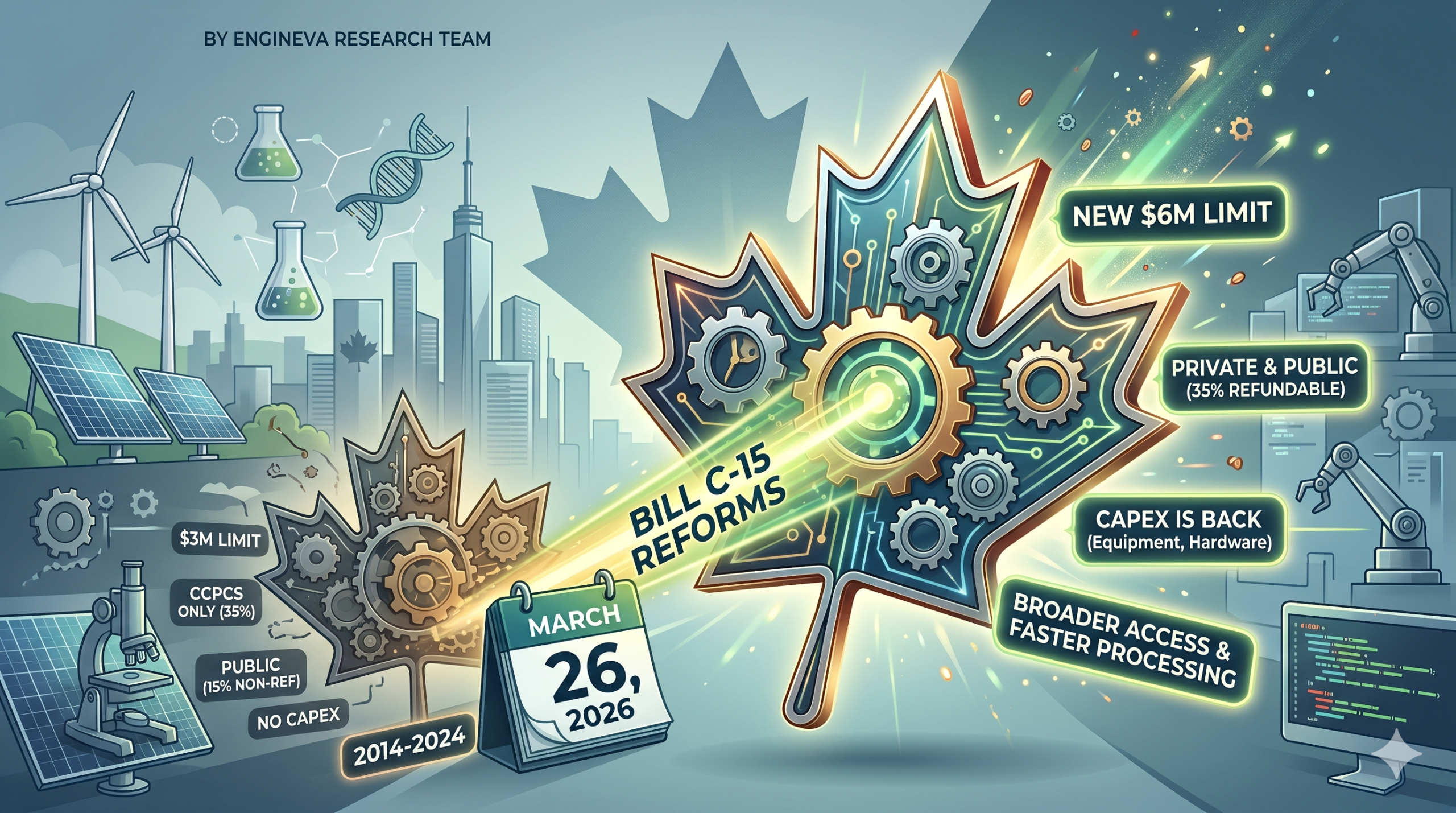
That changed on March 26, 2026, when Bill C-15 received royal assent, putting into law the most significant expansion of the Scientific Research and Experimental Development (SR&ED) tax credit program in over ten years.
The federal government’s stated ambitions are clear: drive more private investment into Canadian R&D, simplify program administration, and cut SR&ED claim processing times in half.
For the engineers, founders, and finance leaders who actually do the work — and for the Canadian-controlled private corporations (CCPCs) and eligible Canadian public corporations (ECPCs) that employ them — this is genuinely transformative.
What Changed: The Three Pillars of Bill C-15
The reforms apply to tax years starting after December 16, 2024, with the new capital expenditure rules covering eligible expenditures made on or after that date. Updated CRA tax forms reflecting the changes are expected in May 2026.
Three major shifts sit at the heart of the bill — together, they widen the door, raise the ceiling, and bring back a category of expenditure that R&D-heavy businesses have been carrying without tax recognition since 2014.
1. CCPCs: A Bigger 35% Refundable Credit, with Broader Access
The annual enhanced expenditure limit for an associated group of CCPCs has doubled — from $3 million to $6 million.
That single change pushes the maximum refundable credit from $1.05 million up to $2.1 million per year.
The taxable capital thresholds governing access to the enhanced rate have also moved up:
- Phase-out begins: raised from $10 million to $15 million
- Phase-out complete: raised from $50 million to $75 million
In practical terms, larger and more mature CCPCs that previously aged out of the enhanced rate can now stay in.
There’s also a new option for early-stage and capital-intensive companies: CCPCs can elect to use a gross revenue test instead of taxable capital. For founders who’ve raised a meaningful round and deployed capital into infrastructure but aren’t yet generating significant revenue, this election can preserve full access to the 35% refundable rate.
2. Public Companies Are Finally at the Table
This may be the single most consequential change in the bill.
Until now, Canadian public corporations have been limited to the 15% non-refundable rate — useful, but a fraction of what private companies could access. Bill C-15 extends the 35% refundable rate to eligible Canadian public corporations and their subsidiaries, on up to $6 million of qualifying R&D expenditures annually.
To qualify as an ECPC, a corporation must — throughout the tax year:
- Be a Canadian resident
- Be listed on a designated stock exchange
- Not be controlled, directly or indirectly in any manner, by one or more non-resident persons
The shift from non-refundable to refundable is the critical part. A non-refundable credit only helps if you have tax to pay; a refundable credit comes back as cash regardless of profitability. For Canadian public companies still investing heavily in R&D and not yet consistently profitable — a description that fits a great many tech, cleantech, and life sciences names — this is a fundamentally different value proposition.
Eligibility is governed by a new gross revenue test based on a three-year rolling average:
- Phase-out begins: average gross revenue exceeds $15 million
- Phase-out complete: average gross revenue reaches $75 million
Gross revenue is taken from the corporation’s annual financial statements prepared under GAAP. For corporate groups that file consolidated statements, the calculation runs at the highest level of consolidation, and group members share access to the enhanced expenditure limit.
The three-year averaging is a quiet but important detail — it rewards consistent, sustained R&D commitment rather than one-off spikes, which mirrors how serious innovation programs are actually built.
3. Capital Expenditures Are Back in the Pool
For the first time since 2014, qualifying capital expenditures — including certain lease costs — are once again eligible for the SR&ED credit and can be deducted in the year incurred as part of the eligible expenditure pool.
To qualify, the capital expenditure must:
- Use all or substantially all (90% or more) of its expected useful operating time in the performance of SR&ED in Canada, and
- Consume all or substantially all of its value in the performance of SR&ED in Canada
Equipment used for both SR&ED and non-SR&ED activities will require additional documentation to support the claim — something to flag early to engineering and operations teams who share lab space, test rigs, or specialized tooling across multiple projects.
The practical impact is significant. Custom prototype hardware, dedicated test benches, specialized instrumentation, and R&D-only manufacturing equipment are all back inside the credit envelope. For hardware, cleantech, advanced manufacturing, and any business where R&D is fundamentally a physical activity, this reverses a restriction that has shaped capital planning for over a decade.
Who Benefits Most — and How
Bill C-15 doesn’t just raise numbers; it redraws the map of who SR&ED is for.
Examples of Companies Whose SR&ED Position Just Changed
- “We’re a public Canadian tech company spending $5M annually on R&D — we’ve always claimed at 15% non-refundable.”
→ Under Bill C-15, you may now qualify for the 35% refundable rate, with refundable credits of up to $2.1 million annually — recovered as cash, not as a future tax offset. - “We’re a CCPC that crossed $10M in taxable capital last year and started losing access to the enhanced rate.”
→ The new $15M / $75M thresholds may put you back inside the enhanced rate envelope. The phase-out math has fundamentally changed. - “We just bought $400,000 of dedicated test equipment for a new product platform.”
→ If the equipment meets the all-or-substantially-all (90%) test for SR&ED use in Canada, that capital expenditure is now part of your eligible expenditure pool.
Each of these scenarios was either ineligible or partially eligible under the old rules. Under Bill C-15, they’re either fully eligible or eligible at a meaningfully higher rate.
How to Position Your Business for the New Rules
To capture the full value of Bill C-15, businesses should treat the next claim cycle as a fresh assessment, not an extension of last year’s approach.
1. Re-Evaluate Your Eligibility from Scratch
If you’re a public corporation that’s been claiming at 15%, or a CCPC that previously aged out of the enhanced rate, your eligibility status under the new rules may look very different.
Don’t extrapolate from last year — start with a clean review.
2. Tighten Up Your Documentation
A bigger, broader program comes with more scrutiny on what’s actually eligible — particularly for shared-use equipment and capital expenditures.
Strong contemporaneous records — the kind made during the work, not reconstructed at year-end — are what separate a clean claim from a contested one.
3. Bring SR&ED into Capital Planning
With qualifying capital expenditures back in scope, the after-tax math on R&D-dedicated equipment has shifted meaningfully.
Procurement decisions made during the current and upcoming fiscal years should reflect the new reality — not the 2014–2024 framework that excluded them.
4. Consider the Gross Revenue Election Carefully
For CCPCs choosing between the taxable capital and gross revenue tests, the right answer depends on your specific balance sheet, revenue trajectory, and corporate group structure.
Modelling both methods before filing is essential — and the better choice may shift year over year.
Why This Matters for Canada’s Innovation Future
Canada has long competed for R&D investment against jurisdictions with deeper capital pools and larger domestic markets. The SR&ED program has been one of the country’s most powerful tools for keeping high-value technical work — and the talent that does it — here at home.
Bill C-15 sharpens that tool considerably. Higher limits, broader eligibility, a revenue-based calculation option, and the return of capital expenditures together expand both who the program reaches and how much value it delivers to each claimant.
For engineering-led businesses, the message is direct: the program now rewards more of what you were already doing, at a higher rate, on a broader base, with more flexible qualification rules.
Final Thoughts
Tax reform rarely lines up neatly with the realities of innovation work. Bill C-15 is a notable exception — a set of changes that reflects how modern Canadian R&D is actually structured, financed, and scaled.
For companies doing serious technical work in Canada, the practical question isn’t whether SR&ED has improved. It clearly has. The question is whether your next claim is positioned to capture the full benefit of a program that now offers bigger credits, broader eligibility, and a more flexible expenditure base than at any point in the past decade.
At Engineva, we help Canadian innovators identify, document, and defend their SR&ED-eligible work under the new Bill C-15 framework.
From public company eligibility reviews and CCPC threshold modelling to capital expenditure documentation and gross revenue election analysis, our team ensures every eligible dollar is captured, quantified, and fully funded.
📞 Book a consultation to explore how Bill C-15 changes your SR&ED position — and turn this legislative reform into your next chapter of Canadian R&D growth.