
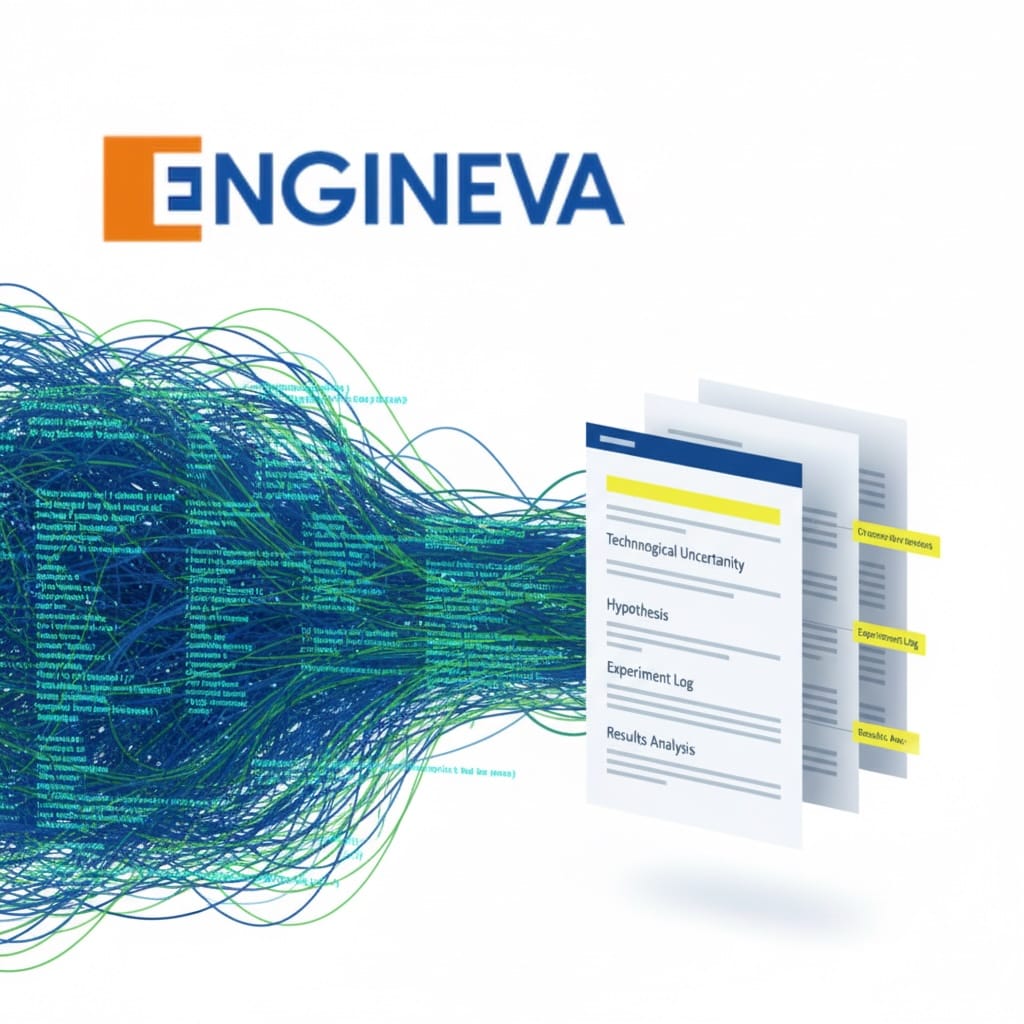
Why Software SR&ED Claims Face Extra Scrutiny
Software and technology development drive some of Canada’s most innovative work—but they also represent one of the most challenging areas for SR&ED eligibility.
Unlike traditional R&D, software projects often produce no physical prototypes or measurable lab data. The work happens in code, data pipelines, and algorithms, which makes it harder to demonstrate systematic investigation and technological uncertainty. As a result, software SR&ED claims are frequently rejected, not because they are ineligible, but because the underlying technical story is not clearly documented.
Through years of CRA workshops and case reviews, consistent lessons have emerged. At Engineva, we have distilled them into three practical strategies that any technology company can apply to strengthen SR&ED documentation, eligibility, and compliance.
Lesson 1: Build Documentation That Works for You and the CRA
The strongest SR&ED claims share one common element—clear, contemporaneous documentation.
In most software environments, this evidence already exists in your team’s workflow. It simply needs to be structured so the CRA can follow your experimental process.
How to make your documentation audit-ready:
Capture evidence as work happens
Export sprint boards, Git commits, and testing logs at the end of each iteration. Add short notes on technical blockers, unexpected results, and performance variations. Dated records prove that experimentation occurred in real time.
Tag technical challenges properly
Add SR&ED-specific fields in your tracking system such as “Uncertainty,” “Hypothesis,” and “Outcome.”
Example: “We tested whether distributed caching across three clusters could achieve sub-50ms query latency under 5,000 concurrent sessions.”
Keep a shared SR&ED archive
Store test logs, architecture diagrams, and experiment notes in one central folder or repository. Review it quarterly to ensure completeness and clarity.
Result: When your JIRA tickets and Git commits already show technical uncertainty, hypothesis testing, and iteration, your year-end SR&ED write-up practically writes itself.
Lesson 2: Describe Technological Uncertainty the Way the CRA Expects
Many denied claims fail at this fundamental step—the uncertainty is not clearly defined.
The CRA’s 2015 Eligibility of Work for SR&ED Investment Tax Credits Policy defines technological uncertainty as a situation where it is not known whether a specific result or objective can be achieved, or how to achieve it, based on the available technological knowledge or experience. In software, this uncertainty often involves scalability, timing, concurrency, integration, or deterministic performance under new constraints.
Examples of valid technological uncertainty:
- Determining whether an AI model can maintain accuracy under on-device quantization.
- Achieving deterministic multi-threaded synchronization without loss of precision or deadlock.
- Maintaining transaction integrity when extending an event-driven microservice beyond its designed concurrency limits.
Examples that are NOT uncertainty:
- Implementing known frameworks or libraries.
- Adapting existing tools through configuration.
- Achieving business performance targets (cost reduction, speed, UX improvements) without technical investigation.
The CRA’s expectation: Clearly separate what was uncertain from how you tested it. A good claim identifies the knowledge gap, the experimental approach, and the resulting insight.
Lesson 3: Maintain Real-Time Evidence, Not Retroactive Reports
One of the CRA’s strongest indicators of legitimacy is contemporaneous documentation—records created while the work is happening. Retroactive reporting, by contrast, risks losing critical detail or introducing hindsight bias.
Simple workflow practices that build real-time SR&ED evidence:
- Encourage engineers to record findings immediately after each experiment or test.
- Use a shared R&D log or internal wiki to track hypotheses, variations, and conclusions.
- Capture sprint retrospectives summarizing what worked, what failed, and what was learned.
- Include test data, screenshots, and benchmark charts directly in documentation threads.
Pro tip: Even small technical discussions in Slack or Teams channels can serve as legitimate SR&ED documentation when archived properly.
Example: From Weak to Strong SR&ED Framing
| Weak Statement | Strong Statement (CRA-Compliant) |
|---|---|
| “We built an AI recommendation engine that increased engagement by 40%.” | “We investigated whether collaborative filtering could operate within 200ms latency on mobile devices. Known matrix decomposition algorithms exceeded memory thresholds, so we designed and tested sparse matrix and approximate-neighbor methods to determine feasibility.” |
The difference is not the sophistication of the work—it is the clarity of the technical uncertainty, hypothesis, and experimental approach.
Checklist: What CRA Reviewers Look For in Software SR&ED
✅ Uncertainty clearly defined — What problem had no known solution?
✅ Advancement evident — What did the team learn that was not previously understood?
✅ Systematic process — Were hypotheses formed, tested, and analyzed?
✅ Contemporaneous documentation — Can you show that this work occurred as claimed?
✅ Evidence of iteration — Do your commits, test results, and notes demonstrate multiple tested approaches?
If all five boxes are checked, your claim is built on solid technical ground.
Embedding SR&ED Awareness into Development Culture
The most successful technology claimants treat SR&ED tracking as part of their engineering culture, not an annual paperwork exercise.
Practical habits include:
- Running a short quarterly SR&ED review to flag potential projects early.
- Assigning an “SR&ED lead” within each technical team.
- Keeping CRA’s three core pillars—uncertainty, advancement, systematic investigation—visible in your documentation templates.
By normalizing SR&ED thinking across your development process, your team stays compliant, your records stay organized, and your claim becomes audit-ready by design.
Final Thoughts
For software and AI companies, SR&ED success depends on clarity, consistency, and credible documentation. When the CRA can clearly trace how your team addressed a real technological uncertainty through systematic experimentation, your claim becomes defensible and repeatable.
At Engineva, we help technology innovators translate complex code-based work into CRA-validated R&D evidence—ensuring your SR&ED credits are maximized and fully supported.
📞 Book a consultation to review your software or AI development work and uncover hidden SR&ED opportunities. Engineva helps you claim smart, stay compliant, and build confidently.