
By Engineva Research Team
Clean Technology, Battery Recycling, Innovation Funding
The Race to Close the Battery Loop
As electric vehicle adoption continues to surge, so does the volume of spent lithium-ion batteries entering the waste stream.
This creates a critical industrial challenge: how to recover valuable metals and materials safely, efficiently, and sustainably — before resource shortages and environmental liabilities collide.
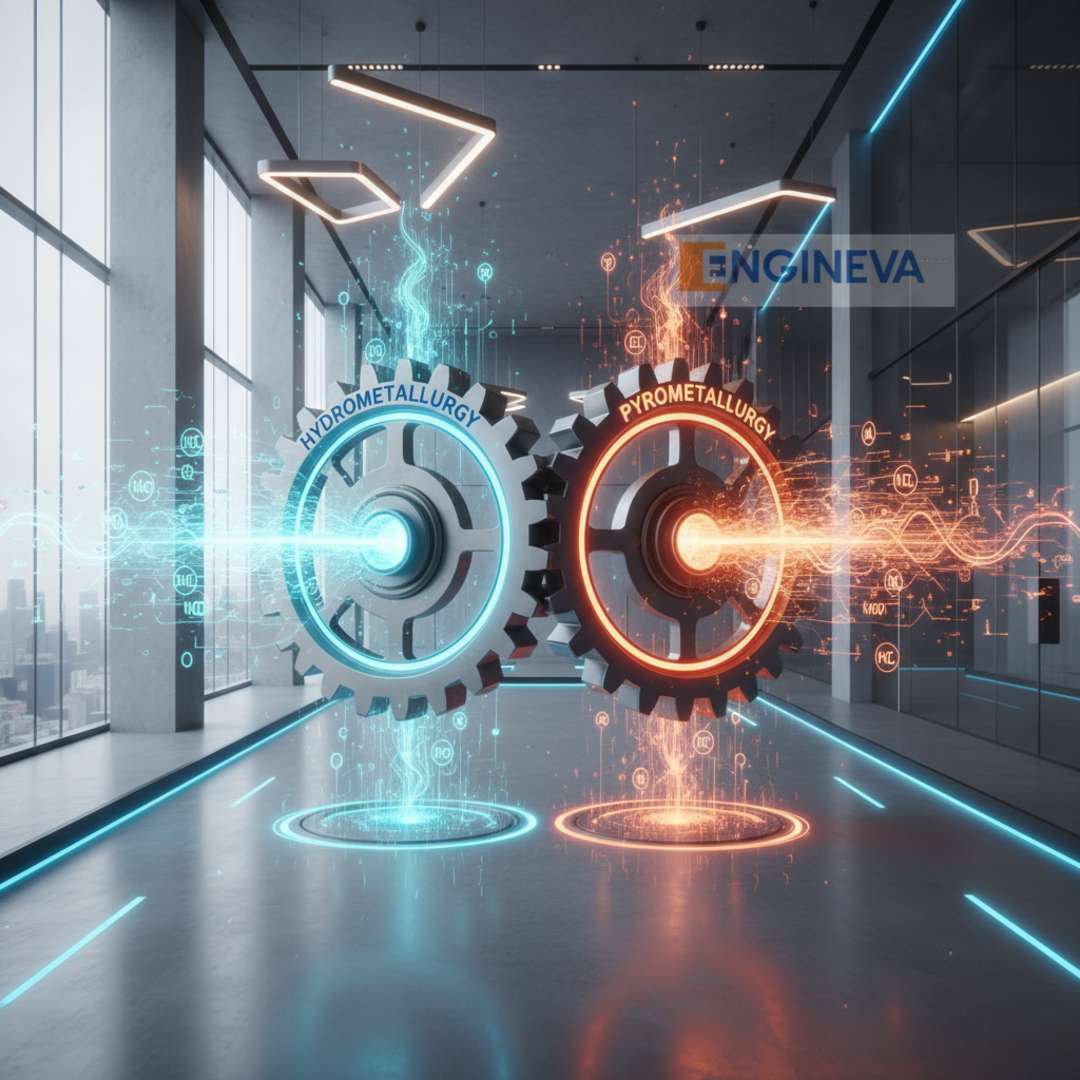
Two methods are shaping the future of large-scale recycling:
- Hydrometallurgy, which dissolves and separates metals through chemistry.
- Pyrometallurgy, which uses heat to extract them through smelting.
Both are promising — but both also face persistent technical uncertainties, the kind that drive research, experimentation, and policy support across Canada’s clean technology landscape.
Hydrometallurgy: Precision through Chemistry
Hydrometallurgy relies on a series of aqueous chemical reactions to extract metals like lithium, cobalt, and nickel.
The process typically involves leaching, filtration, and selective precipitation to achieve battery-grade purity.
Advantages
- High recovery yields and low emissions
- Adaptability to different chemistries
- Potential for closed-loop material reuse
Challenges
Scaling hydrometallurgical systems introduces significant R&D hurdles. Engineers must:
- Balance reagent efficiency with selectivity
- Minimize co-precipitation
- Manage waste streams without degrading recovery rates
These are precisely the kinds of technical uncertainties that define ongoing SR&ED-eligible experimentation — where every parameter change becomes an experiment in process optimization.
Pyrometallurgy: Throughput through Heat
Pyrometallurgy, by contrast, relies on smelting and refining at temperatures above 1,000°C.
The heat separates metals into an alloy phase, leaving other compounds in a slag byproduct.
Advantages
- Handles mixed or contaminated feedstock with minimal pre-treatment
- Scales easily to industrial levels
- Proven metallurgy base
Challenges
- High energy consumption
- Potential lithium loss to slag
- Complex off-gas management for environmental compliance
Canadian researchers are now developing hybrid “pyro-hydro” systems — using pyrometallurgy for front-end volume reduction, followed by hydrometallurgical purification.
The goal: combine industrial throughput with high recovery efficiency.
Hydro vs. Pyro: Two Halves of a Circular System
| Aspect | Hydrometallurgy | Pyrometallurgy |
|---|---|---|
| Core Mechanism | Chemical dissolution | Thermal separation |
| Strength | High purity, low emissions | High throughput, flexible input |
| Limitation | Complex chemistry management | Energy intensity, lithium loss |
| Best Application | Fine recovery and purification | Mixed or contaminated feedstock |
| Emerging Trend | Organic acid and bio-leaching systems | Hybrid pyro-hydro integration |
Rather than competitors, hydro and pyro processes are increasingly complementary.
Future recycling facilities will integrate both into modular, adaptive systems capable of handling evolving battery chemistries.
The Role of R&D Incentives in Advancing Recycling Innovation
Developing these next-generation recycling systems requires extensive experimentation and technical labour.
Fortunately, Canada’s innovation funding ecosystem is designed to support precisely this kind of high-impact industrial R&D.
A coordinated combination of federal and provincial programs can help recover 50–60% of eligible costs, including:
- Engineering design and testing of extraction or refining systems
- Development of new leaching agents or separation methods
- Pilot-scale validation of process control and instrumentation
- Energy efficiency and emissions reduction technologies
Key Funding Programs
- SR&ED — Tax-based R&D incentives
- IRAP — Innovation project grants
- SDTC — Sustainable Development Technology Canada
- Provincial Clean-Tech Funds — Targeted regional programs
Together, these tools form a powerful framework for de-risking technology development, allowing innovators to:
- Extend experimentation without exhausting cash flow
- Maintain research continuity between funding rounds
- Keep intellectual property and commercialization within Canada
This is not just financial recovery — it’s strategic leverage that strengthens Canada’s position in the global clean-tech race.
Innovation Through Uncertainty
Every incremental improvement in battery recycling — every test, failure, and iteration — represents technological advancement.
Unanswered questions define the next wave of eligible R&D:
- Can leaching be made more selective at lower temperatures?
- Can smelting furnaces recover lithium without increasing emissions?
- Can real-time analytics automate impurity control in continuous systems?
Each question marks a new area of experimental development, bringing Canada closer to a sustainable, circular battery economy.
Final Thoughts
Hydrometallurgy and pyrometallurgy are not competing philosophies — they are complementary disciplines in the shared mission to close the loop on clean energy materials.
Through sustained research, cross-sector collaboration, and the intelligent use of R&D incentives, Canada is positioned to lead the world in safe, scalable, and economically viable battery recycling.
The next wave of innovation won’t be about which process wins — but about how efficiently we make both work together.
At Engineva, we help innovators translate experimental process development into fundable, defensible R&D.
Our team aligns technical documentation, funding strategy, and compliance to ensure your recycling, materials, and clean-tech projects capture their full eligible value — from tax credits to non-dilutive grants.
📞 Book a consultation to explore how Canada’s combined R&D funding ecosystem can help recover a significant share of your innovation costs and accelerate your journey toward circular manufacturing.