
Budget 2026 and SR&ED: Finally Paying for the Last Mile?
Every founder knows the moment. The prototype works. The engineers are high-fiving. And then someone from regulatory affairs walks in with a binder, a timeline and a budget that makes the R&D spend look like a rounding error.
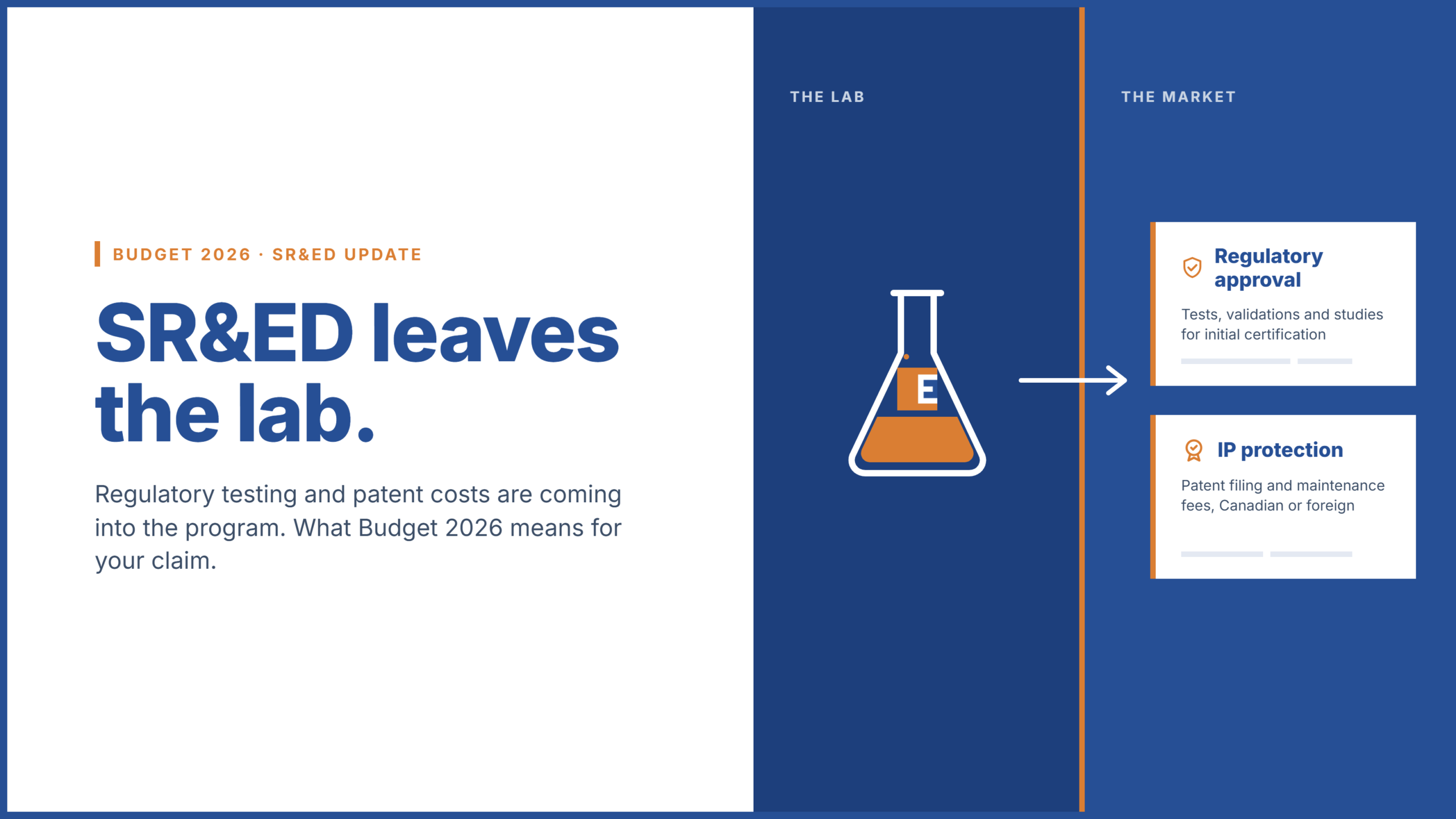
For forty years, SR&ED has stopped at the lab door. The experiments were supported. The certification testing, the patent filings, the long march to a Health Canada licence or a CSA mark were yours to carry alone.
On November 5, Budget 2026 proposed to change that. Here is what it actually says, what it does not say, and what to do about it before your next fiscal year starts.
Two new doors, one old key
The budget adds two categories of commercialization cost to SR&ED. The first is regulatory approval and certification: the tests, technological validations and studies you need to obtain the initial approval to sell a product or process. Think biocompatibility testing for a medical device, or UL certification for a new inverter.
The second is intellectual property protection: preparing and filing patents, certificates of supplementary protection, plant breeders’ rights and copyrighted software, plus the maintenance fees that follow. Foreign patent office fees count. Litigation does not.
The price tag is $930 million over five years and $235 million a year after that. The claimable cost types are the ones you already track: salaries, materials, contracts, overhead and equipment.
The key, though, is the same old one. Both doors open only from inside a project that already qualifies as SR&ED. No technological uncertainty, no commercialization credit.
Not a raise, a longer runway
Let us be clear about what did not change. The 35% refundable credit still applies to the first $6 million of qualifying spend for CCPCs and eligible Canadian public corporations. The 15% non-refundable rate still covers the rest. The new costs do not get their own pool; they compete for room under the same cap.
So this is not a richer SR&ED. It is a longer one. For a company that spends $4 million on R&D and $500,000 getting the result approved and patented, the credit base grows by an eighth. For a company already pressing against the $6 million limit, it grows by nothing.
There is also a catch on the IP side. Sell a patent whose filing costs you claimed, and the related deduction and credit are recaptured. Build to hold, not to flip.
Check your calendar before you celebrate
The measure applies to taxation years that begin on or after November 5, 2026. Read that twice. A December 31 year-end company gets nothing until its 2027 tax year. A company with a November 30 year-end is in on December 1, 2026.
That makes the next few months a planning window, not a claiming window. Start separating initial regulatory testing from routine quality control now. Ask your patent counsel to split invoices into foreign fees, Canadian drafting (and where it was done), maintenance and enforcement. Record which SR&ED project each approval or filing came out of. When the first eligible year opens, you want the trail already laid.
Standing on Bill C-15’s shoulders
If this feels like the second act, it is. Bill C-15 received Royal Assent on March 26, 2026, and it carried the Budget 2025 changes into law: the expenditure limit doubled from $3 million to $6 million, the taxable-capital phase-out moved to $15 million through $75 million, eligible public corporations gained the refundable credit, and capital expenditures came back after a decade in exile.
Those changes apply to returns being filed today. If you bought lab equipment after December 15, 2024 and have not revisited your claim, that is the more urgent conversation. Budget 2026 is tomorrow’s money. Bill C-15 is this year’s.
The CRA’s pre-claim approval process, live since April 1, 2026, matters more now too. It confirms a project qualifies as SR&ED for up to three years. With commercialization costs riding on that same project, up-front certainty is worth paying attention to.
Engineva’s approach: eligibility first, then the extras
At Engineva, we have watched plenty of clients finish a brilliant R&D project and then disappear into a certification process that cost more than the research. We welcome the change. We also know how the CRA reads new rules: narrowly, at first, and with a sharp eye on whether the underlying project was ever SR&ED to begin with.
Our advice is to treat the commercialization expansion as a reward for a well-documented project, not a reason to stretch one. Nail the technological uncertainty and the systematic investigation. Then let the regulatory testing and the patent filings follow the project they belong to. Done in that order, the new costs are a clean addition. Done backwards, they are an audit invitation.
The better question to ask
The tempting question is, “Can I claim my regulatory testing now?”
The better question is, “Which of my projects clearly qualifies as SR&ED, and when does my first eligible tax year begin?” Answer that, and the commercialization credit takes care of itself.
The measure still has to pass the House on November 17, then move to draft legislation and CRA guidance. The budget also commits the CRA to sector-specific guidance on what counts as a commercialization expense, which is where the real answers will come from for any industry whose products need a regulator’s sign-off or a patent before they can be sold. We will update this post as that guidance is released. In the meantime, your current claims are unaffected: keep filing as usual.
Final thought
Budget 2026 did not raise the SR&ED rate. It moved the finish line. For the first time, the program reaches from the first experiment to the first approval and the first patent. That is a real change for Canadian innovators who have carried the last mile alone, and it rewards the companies that start preparing now.
Want to know how Budget 2026 and Bill C-15 apply to your projects and your fiscal year? Book a free SR&ED assessment with the Engineva team.
SR&ED, Budget 2026, Bill C-15