
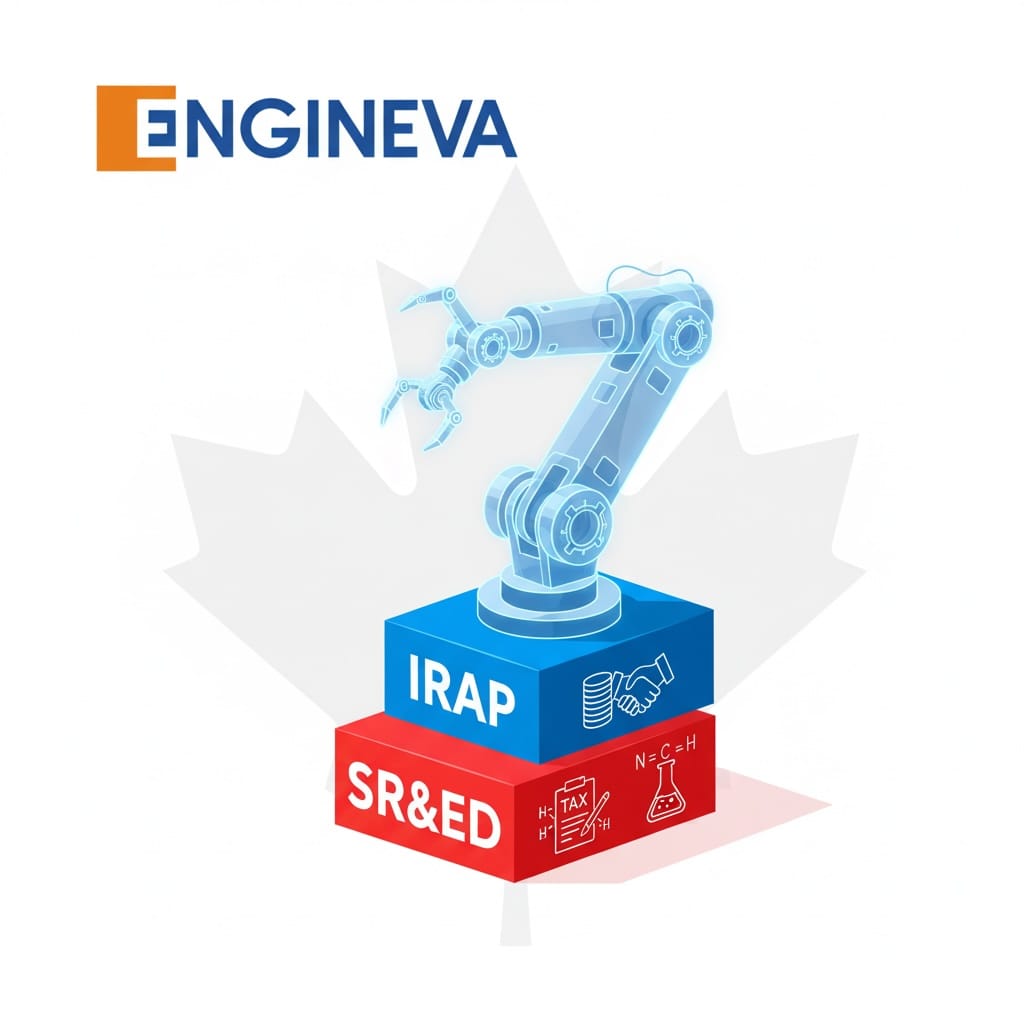
SR&ED vs IRAP: How to Combine Canada’s Two Most Powerful R&D Funding Programs
By Engineva Research Team | Government Funding, SR&ED, IRAP, Innovation Strategy
Two Programs. One Mission: Fueling Canadian Innovation
If your company invests in research and development, two federal programs should be on your radar:
The Scientific Research and Experimental Development (SR&ED) tax credit, administered by the Canada Revenue Agency (CRA)
The Industrial Research Assistance Program (IRAP), managed by the National Research Council (NRC)
Both programs aim to support Canadian innovation, but they operate in fundamentally different ways.
Understanding those differences—and how to strategically combine them—can help you maximize non-dilutive funding while keeping your cash flow healthy.
1 Timing of Funding: When You Get the Money
The biggest distinction between SR&ED and IRAP is when and how funds are received.
| Program | Funding Type | Timing | Ideal For |
|---|---|---|---|
| SR&ED | Tax Credit | Paid after your fiscal year once your claim is filed | Companies that can finance R&D internally and recover costs later |
| IRAP | Grant | Reimbursed monthly as project expenses are incurred | Companies that need cash flow support during development |
SR&ED provides a retroactive refund—great for offsetting completed R&D.
IRAP provides upfront support—ideal for projects that require immediate funding to move forward.
Many companies use last year’s SR&ED refund to co-fund this year’s IRAP-backed development, creating a continuous innovation cycle.
2 Funding Amounts and Coverage
Both programs fund similar types of work—research and experimental development—but the rates and coverage models differ.
| Program | Federal Support Level | Eligible Costs |
|---|---|---|
| SR&ED | 35% refundable federal credit for CCPCs on first $3M in eligible costs (plus 10–20% provincial) | Salaries, subcontractors, materials, overhead |
| IRAP | Typically 50–80% of eligible salaries and 50% of subcontractor costs | Salaries, contractor fees, limited materials and travel |
SR&ED is a tax credit, not a grant. You claim it after the work is completed and your financials are filed.
IRAP is a grant that reimburses specific project costs throughout development.
The two programs complement each other: IRAP accelerates your project now, SR&ED reimburses what remains later.
3 Application and Evaluation Process
| Aspect | SR&ED (CRA) | IRAP (NRC) |
|---|---|---|
| Submission Timing | After fiscal year-end | Before project begins |
| Review Type | Legal and technical assessment under Income Tax Act | Competitive merit review by NRC Industrial Technology Advisors (ITAs) |
| Focus | Scientific or technological uncertainty | Commercial potential and national innovation value |
| Competition | Non-competitive—if eligible, you qualify | Competitive—funding is limited and project-based |
SR&ED rewards the presence of technological uncertainty.
IRAP rewards the potential impact of the solution on Canada’s innovation ecosystem.
4 Can You Combine SR&ED and IRAP?
Yes—this is known as funding stacking, and it is completely allowed with careful coordination.
The rule is simple:
You cannot claim the same expense twice.
If IRAP reimburses a portion of an engineer’s salary, that portion must be excluded from your SR&ED claim.
However, you can still claim the remaining eligible portion.
Example
| Description | Amount | Eligible for IRAP | Eligible for SR&ED |
|---|
| Engineer salary | $100,000 | $60,000 (covered by IRAP) | $40,000 (claimed under SR&ED) |
|---|---|---|---|
| Total R&D expenditure | $100,000 (split between both programs) |
This approach still provides significant combined benefits. IRAP supports your ongoing cash flow, while SR&ED returns additional funds after year-end.
5 Key Strategic Considerations
Start with IRAP for cash flow
IRAP can fund your immediate payroll costs and technical milestones while your project is in development.
Follow with SR&ED for retroactive recovery
Once your fiscal year ends, claim SR&ED on the remaining eligible costs that were not covered by IRAP.
Document rigorously
Keep separate records for IRAP-funded and SR&ED-funded activities. Both programs require detailed technical and financial documentation, but IRAP’s monthly reporting can actually strengthen your SR&ED evidence.
Leverage professional alignment
Some of the most successful innovators work with SR&ED consultants who collaborate directly with their NRC ITA, ensuring consistent definitions of scope, uncertainty, and advancement.
6 Which Program Fits Your Business?
| Priority | Choose SR&ED if… | Choose IRAP if… |
|---|---|---|
| Cash flow | You can finance R&D internally | You need ongoing reimbursement during development |
| Project scope | Long-term technical exploration | Defined milestones and deliverables |
| Eligibility focus | Technological uncertainty and advancement | Commercial feasibility and market impact |
| Administration | Year-end claim submission | Monthly progress reporting |
Most growing companies benefit from using both programs strategically—SR&ED for breadth and IRAP for immediacy.
7 Real-World Scenario
Company: Polaris Automation Inc.
Project: Development of a next-generation control algorithm for robotic assembly systems.
Polaris secured $120,000 in IRAP funding to support six months of initial research and prototyping.
After the project’s completion, the company claimed $280,000 in additional SR&ED credits on remaining salaries and materials not covered by IRAP.
Result: A combined recovery of nearly $400,000—funding that was reinvested directly into commercialization.
8 The Smart Funding Formula
Plan early – Engage both CRA and NRC advisors before projects start.
Allocate clearly – Divide project budgets into IRAP-eligible and SR&ED-eligible portions.
Track meticulously – Maintain time sheets, experiment logs, and expense reports.
File promptly – Submit IRAP reports monthly and SR&ED claims within 18 months of year-end.
Review annually – Update your funding strategy as tax rules and NRC priorities evolve.
Final Thoughts
SR&ED and IRAP are two sides of Canada’s innovation coin—one rewards experimentation, the other rewards impact.
Used together, they can fund a significant portion of your R&D roadmap and create a sustainable engine for growth.
At Engineva, we help Canadian innovators map their entire funding ecosystem—aligning SR&ED, IRAP, and provincial programs into one cohesive strategy.
📞 Book a consultation to discover how much more your R&D work could earn through coordinated funding.
Engineva helps you claim smart and grow confidently.
Disclaimer: This article provides general information only and does not constitute professional tax or legal advice. Consult a qualified SR&ED or IRAP specialist to determine how these programs apply to your specific situation.